



The 11-BM mail-in program now uses the SRS Mail-In System for base requests, sample registration, scan requests, and data access.
Users should log in to the SRS Mail-In System and follow the workflow shown on the main user page. New users should begin by requesting sample bases for an approved proposal. After bases are assigned, users can register samples, wait for beamline staff approval, submit scan requests, and download completed data.
If you have trouble logging in or do not see your proposal, contact 11-BM staff at [email protected].
For 11-ID-B and 17-BM mail-in users, instructions can be found here .
General Notes
Carefully read and follow these instructions to ensure a successful mail-in experiment. Contact 11-BM staff with questions at anytime.
Please note the APS run Schedule and proposal Calendar dates.
Samples arriving during or just a shutdown will be saved and run in the following cycle. Contact staff for details.
Proprietary industrial users should consult additional instructions about performing experiments at the APS.
Please note additional important APS safety guidelines. Although many apply only to on-site users, Mail-In users should review notes for Experiment Hazard Classes and restrictions on the Shipping of Samples.
Mail-In Workflow Summary
1. Submit a GUP proposal through the APS proposal system.
2. After the proposal is accepted and available in the SRS Mail-In System, log in and request sample bases.
3. Wait for beamline staff to assign bases. You will receive an email with assigned barcode(s).
4. Receive the bases by mail or pick them up locally if local pickup was selected.
5. Register samples in the SRS Mail-In System.
6. Wait for beamline staff approval and ESAF creation.
7. Add scan requests for approved samples.
8. Ship samples to Argonne only after registration has been approved.
9. Log in to view sample status and download completed data.
Submit a Proposal
To obtain experimental time at 11-BM, all users must submit a General User Proposal (GUP). Proposals for the rapid access mail-in service are limited to 1 shift (~ 8 hours or 8 samples) per proposal, but may be submitted at anytime. Standard proposals must be submitted prior to the run cycle deadlines (three times per year). Check the GUP calendar for exact dates.
Safety Notice
The mail-in service cannot accept any of the following sample types:
- Biohazards
- Human-Derived Materials
- Radioactive Materials
- Non-Sterilized Regulated Soils
- Explosives or Unstable Materials
Note: we are also unable to accept materials that possesses more than one of the following hazards: flammable, corrosive or oxidizer.
RCRA regulated metals (the heavy metals Ag, As, Ba, Cd, Cr, Hg, Pb and Se) can be accepted, but samples containing them must be identified (see "Register Sample Base Numbers" below).
Additionally, all registered samples shipped to the APS must qualify for small quantity exceptions under U.S. Dept. of Transportation (DOT) regulations (CFR Title 49 § 173.4). Full safety details and definitions are available on the 11-BM Sample Hazard webpage.
Please take special care to ensure that samples potentially hazardous to beamline staff (Nano, Toxic, Carcinogenic, Flammable, etc) are securely contained and permanently sealed in the Kapton tubes.
Inquire about special sized sample mounting bases and double nesting Kapton tubes if your permissible samples are particularly hazardous or air sensitive.
Request Sample Base Kits
After your proposal has been accepted, log in to the SRS mail-in system and choose **Base Requests**.
From this page, select the proposal and request the number and type of sample bases needed. Users may also choose whether the bases should be mailed or held for local pickup at the beamline.
The available base types are:
- Standard: magnetic base for a 0.9 mm Kapton capillary.
- Large: magnetic base for a 1.5 mm Kapton capillary.
After beamline staff assign bases, you will receive an email listing the assigned barcode(s). If the bases are being mailed, the email will show the mailing address on file; notify beamline staff immediately if that address is incorrect.
Receive Sample Base Package
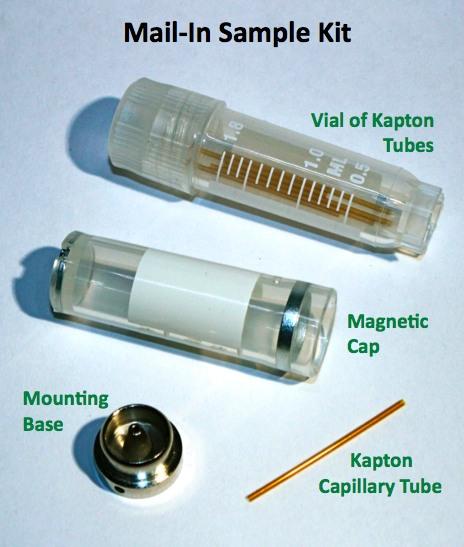
Sample base kits are shipped to your confirmed address. In this package, you will find your requested mail-in sample base kit(s) and a pre-printed return shipping label. For each requested sample base, the package contains the following: one sample mounting base, one magnetic cap, and Kapton sample capillary tubes (inside a plastic vial). Additional Kapton tubes are provided for your convenience. Requests are normally processed within a few days, and packages are sent via the US Mail.
Each part of the sample base kit is described below and shown in the image on the right.
Mounting Base: Holds one sample capillary tube and is integrated with the robotic arm used for automated data collection. The unique barcode (e.g. ANL0AA1234) printed on the side, also encoded in a 2D barcode on the bottom, tracks the sample at all steps of our mail-in service. Note: The barcode number is required when registering each sample online.
Do NOT return any materials to the APS until your samples have been registered, verified, and approved by beamline staff.
Magnetic Cap: A magnetic ring secures caps on mounting bases, and provides some protection for sample capillary tubes during shipment. Please avoid writing on the caps, as they are re-used and cannot be used to identify your sample. Note: all samples must fit completely inside the caps when placed on mounting bases; longer samples may be destroyed by the 11-BM robotic sample loader.
Capillary Tubes: The supplied Kapton tubes have an inner diameter of 0.80 mm, and an outer diameter that fits snugly inside 11-BM mounting bases. Kapton is stable over a wide temperature range and adds a negligible contribution to the diffraction scan background. Note: All sample powders must be fully contained and secured within these capillary tubes.
Prepare Sample Capillaries
Sample preparation is critical and can dramatically impact the quality of your collected data.
See the 11-BM Sample Preparation page for details.
If in doubt - please contact 11-BM staff with any questions on sample preparation before shipping your sample(s).
Register Sample Base Numbers
You must register and receive email approval from 11-BM staff BEFORE mailing any samples to the APS.
Register your sample(s) by logging in to the SRS Mail-In System and choose **Sample Registration**.
For each sample, provide a complete chemical name, a chemical formula that specifies all elements present in the material by the one or two-letter elemental symbol, and an optional sample ID for your records. Do not use non-element symbols to stand for classes of elements (RE for rare-earth, etc). Compositions may be symbolic or approximate [e.g. Na(x)Li(1-x)O]. Also specify the appropriate hazard(s) information.
Check all the hazard boxes that apply. Eight metals (Ag, As, Ba, Cd, Cr, Hg, Pb and Se) are regulated as "heavy metals." If your sample contains any of these, please note that by selecting "Other, specify:" in addition to the other hazards (they would be "Toxic" as well, for example) and note "RCRA Metals" in the text-entry box next to the "Other, specify:" check-box.
You will receive a confirmation email when your sample registration is reviewed and approved; only then may you send samples to the APS (see shipping section below). The provided sample information (once approved) is used to generate an Experimental Safety Approval Form (ESAF) for your experiment. For 11-BM mail-in users, an ESAF is automatically created, submitted and posted on your behalf by beamline staff.
Note: It is important that samples are registered, verified, and approved before shipment to the APS. Unregistered samples received at 11-BM may be destroyed immediately. Repeat offenders may lose mail-in access to 11-BM.
Select Scan Parameters
Mail-in users must select scan parameters for their samples. After sample registration has been approved and the ESAF has been created, log in and choose **Scan Requests**.
The system will show proposals with approved samples. Select the proposal, then add scan requests for individual samples or use the batch scan request option when available.
Custom scan options include select temperatures between 90 K and 490 K, and a choice of more specialized scan parameters (2θ range, step size, etc). The total estimated experiment time is tracked and generally limited to 1 shift (8 hours) per rapid access mail-in proposal. Note: we cannot guarantee the run order of mail-in samples - they will be run in the most efficient sequence for data collection, not necessarily the order you specify.
Send Samples to Argonne
Users are responsible for shipping samples to 11-BM at Argonne in full compliance with DOT rules and regulations (see Safety Notice above). You may use the US Mail or a commercial shipping company (FedEx, UPS, DHL, etc). We recommend protecting samples in bubble wrap (provided) or some other padding during shipment.
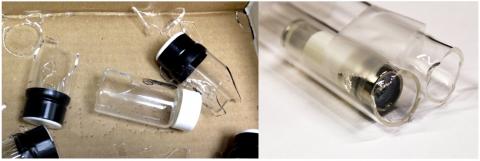
GLASS Regulation: The use of glass vials, ampoules or other containers for shipping 11-BM samples to the APS is now prohibited. (excluding nested sample quartz capillaries). Instead, simply use bubble wrap or plastic containers. Most of the time, glass containers are broken on arrival at the APS, which is dangerous for beamline staff and does nothing to protect your samples.
Do not ship samples until:
1. sample bases have been assigned;
2. sample information has been entered in the SRS Mail-In System;
3. beamline staff have approved the sample registration; and
4. you have received the approval email.
5. you have registered scan requests for all samples.
Email notification will be sent when samples are received at the beamline. Note: we do not track sample base kits sent out, and cannot help track samples shipped back to the APS. Also, do not add a signature requirement for delivery of your package; these samples may be delayed or returned by the laboratory receiving office.
Samples should be shipped to this address:
11-BM Staff 9700 S. Cass Ave, Bldg. 433/D001 Argonne National Laboratory Lemont, IL 60439-4856
International users shipping from outside the U.S. are responsible for all regulations covering international shipment of chemicals. Ensure paperwork required for entry of samples to the U.S. is done in advance and is filed with the shipment. Please note if samples are assigned a value, US Customs may request duty payment. We cannot assist with international shipping paperwork or provide documentation or payment for samples.
Collect Diffraction Data
Email notification will be sent to users once data have been collected on your sample(s). Our goal is to collect data on registered samples within ~3 weeks of receipt at 11-BM. Often data is available much sooner, sometimes within just a few days, but depending on beamline scheduling and the APS operations calendar there may be an unavoidable delay. Once collected, beamline staff reviews each data set and may include comments in the notification email(s) when appropriate.
After data have been collected and reviewed, log in to the SRS Mail-In System and choose **Data**.
The data page lists proposals with completed scan requests. Select a proposal to view completed scans and available data files. Depending on the file type, data may be downloaded directly or viewed in the browser.
Additional information about 11-BM data and file formats is available on the website.
Publish Results
The free mail-in powder diffraction service for non-proprietary research at 11-BM is made possible by funding from the U. S. Department of Energy. By reporting publications that include 11-BM data, you demonstrate the value of this beamline to your research and help ensure that funding for the program is continued.
Proprietary users who do *not* intend to publish their data should consult the APS User Office for help setting up appropriate Proprietary User Agreements.
More information about publishing (and published) 11-BM data is available on the website.
Please report all citations to beamline staff. We will also periodically inquire on the status of unreported mail-in user data via automated emails.
It is APS policy is that publications using data collected at the APS contain the following acknowledgement:
Use of the Advanced Photon Source at Argonne National Laboratory was supported by the U. S. Department of Energy, Office of Science, Office of Basic Energy Sciences, under Contract No. DE-AC02-06CH11357.
Thanking beamline staff is always welcome, but co-authorships are only expected where we have been involved in experiment design or data analysis.
Dispose of Samples
By default, all mail-in samples sent to 11-BM will be saved for a minimum of two weeks after data collection before being disposed.
Under special circumstances, samples may be returned if requested in advance.
Users requesting sample return should arrange for payment of shipping costs (e.g. APS cost code, FedEx #, etc) and MSDS datasheets are required for all compositions. Requests will be processed when beamline operations allow; no specific delivery dates can be guaranteed. Note: sample return is time consuming and could impact the number of accommodated samples; please request return only where samples are of significant value.
international Users: Due to the complexities of overseas sample shipping, we regret that samples cannot be shipped to addresses outside of the U.S. If needed, please find a U.S. based collaborator to assist with international sample return.
Questions / Comments
Thank you for reading all the way to the end, and good luck with your mail-in synchrotron powder diffraction experiment at 11-BM.
Please feel free to contact 11-BM beamline staff at anytime ([email protected]) with your questions, comments, or suggestions about how we can improve this service.